

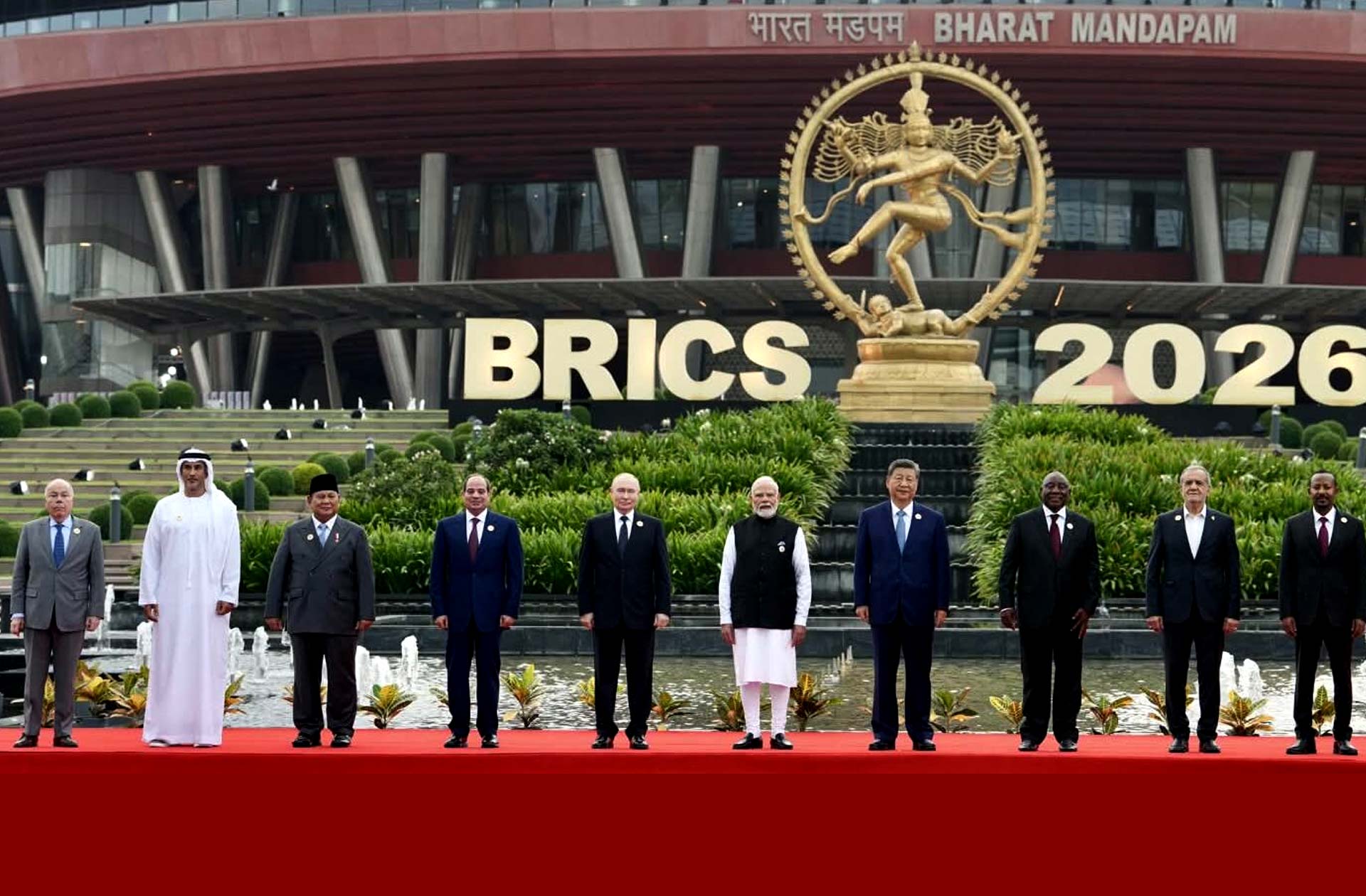
For two days in mid-September, the sprawling glass-and-steel expanse of Bharat Mandapam in New Delhi became the epicenter of a very particular kind of global theater — the kind reserved for summits where the guest list matters almost as much as the agenda. On September 12 and 13, India played host to the 18th BRICS Summit, a gathering that brought together leaders and senior officials from Brazil, Russia, India, China, South Africa, Egypt, Ethiopia, Indonesia, Iran, and the United Arab Emirates, alongside a roster of partner countries and international organizations, all under the banner of India’s 2026 BRICS chairship.
The summit’s chosen motto — “Building for Resilience, Innovation, Cooperation and Sustainability” — doubled as both a mission statement and a fairly accurate description of what BRICS itself has become over the past decade: a loose but increasingly consequential coalition of states united less by shared ideology than by a shared interest in reshaping a global order many of them feel was built without adequate input from the Global South. Prime Minister Narendra Modi, chairing the proceedings, used the occasion to position India as a bridge-builder within the bloc, a role that has become increasingly central to New Delhi’s foreign policy identity as it simultaneously courts Washington, Moscow, and Beijing in different registers depending on the room.
The substantive work of the summit unfolded during a closed plenary session on September 12, where leaders worked through an agenda covering reform of global governance institutions, deeper economic cooperation among member states, and a discussion of major international and regional flashpoints, including de-escalation efforts in the Middle East. That session culminated in the formal adoption, by consensus, of the New Delhi Declaration — the summit’s central diplomatic output and the document against which its success will likely be measured in the months ahead.
While the precise text of the declaration covers considerable ground, its core threads reflect long-standing BRICS priorities: pushing for a larger voice for emerging economies within institutions like the International Monetary Fund and the World Bank, deepening trade and payment cooperation among members in ways that reduce reliance on Western-dominated financial infrastructure, and coordinating positions on development financing that member states argue has too often failed to serve the Global South’s actual needs. Reform of multilateral institutions has been a BRICS talking point for years, but the specific framing adopted at this summit suggests the bloc continues to view itself as a counterweight — not necessarily adversarial, but assertively independent — to the G7-anchored architecture that has governed international economic relations since the mid-twentieth century.
Beyond the formal plenary, the summit carried its own layer of ceremonial choreography that, in gatherings like this, often communicates as much as the official communiqués. Following the closed session, leaders toured the Bharat Innovates exposition, a showcase apparently designed to highlight Indian technological and industrial achievements to visiting delegations, before participating in an official family photograph and a joint tree-planting ceremony — a now-familiar ritual at major diplomatic summits, symbolizing shared commitment to environmental cooperation even as substantive climate policy disagreements between BRICS members persist behind the scenes. The day concluded with a gala dinner hosted by Modi, the kind of setting where sidebar conversations between leaders often prove as diplomatically significant as anything said on the record.
The second day, September 13, broadened the format considerably. Rather than remaining a closed-door affair among full BRICS members, the open plenary brought in partner countries, official invitees, and representatives of international organizations, reflecting the bloc’s ongoing expansion strategy. BRICS has grown substantially since its founding, adding new full members and a growing tier of “partner countries” in recent years — a deliberate strategy that has drawn both admiration from nations seeking alternatives to Western-led forums and skepticism from analysts who question whether an increasingly large and ideologically diverse coalition can maintain enough internal cohesion to translate summit declarations into concrete policy outcomes.
That question of cohesion looms particularly large this year. BRICS membership spans countries with sharply different relationships to Washington, wildly different economic systems, and, in some cases, direct territorial or security tensions with one another. India and China, both founding members, continue to manage an uneasy border relationship even as they sit at the same summit table pushing similar rhetoric about reforming global governance. Iran’s membership adds another layer of complexity, given the country’s fraught relationship with much of the Western world. Holding a coalition like this together long enough to produce meaningful, implementable outcomes — rather than just aspirational declarations — remains BRICS’s most persistent structural challenge, and this year’s summit did little to resolve that tension even as it papered over it with a successfully adopted joint declaration.
For India specifically, hosting duties carry real diplomatic weight. New Delhi has spent the past several years cultivating an image as a country capable of engaging seriously with virtually every major power bloc simultaneously — deepening defense and technology ties with the United States and its allies while maintaining historic energy and defense relationships with Russia, all while sitting at the table with China inside BRICS despite ongoing bilateral friction. Successfully chairing a summit of this scale, and securing consensus on a joint declaration among a group with as many internal fault lines as BRICS currently has, gives Modi’s government a tangible diplomatic accomplishment to point to, regardless of how much concrete policy change ultimately follows from the New Delhi Declaration’s language.
What happens next will depend largely on follow-through — the perennial challenge for any multilateral summit of this kind. Declarations adopted with fanfare in gilded conference halls have a well-documented tendency to generate less durable change than their signing ceremonies suggest. Still, for a bloc that continues to expand its membership and its ambitions year over year, the New Delhi Declaration represents another data point in BRICS’s slow, uneven, but persistent effort to carve out an alternative center of gravity in global governance — one where India, at least for this particular summit cycle, got to sit at the head of the table.



0 Comments