

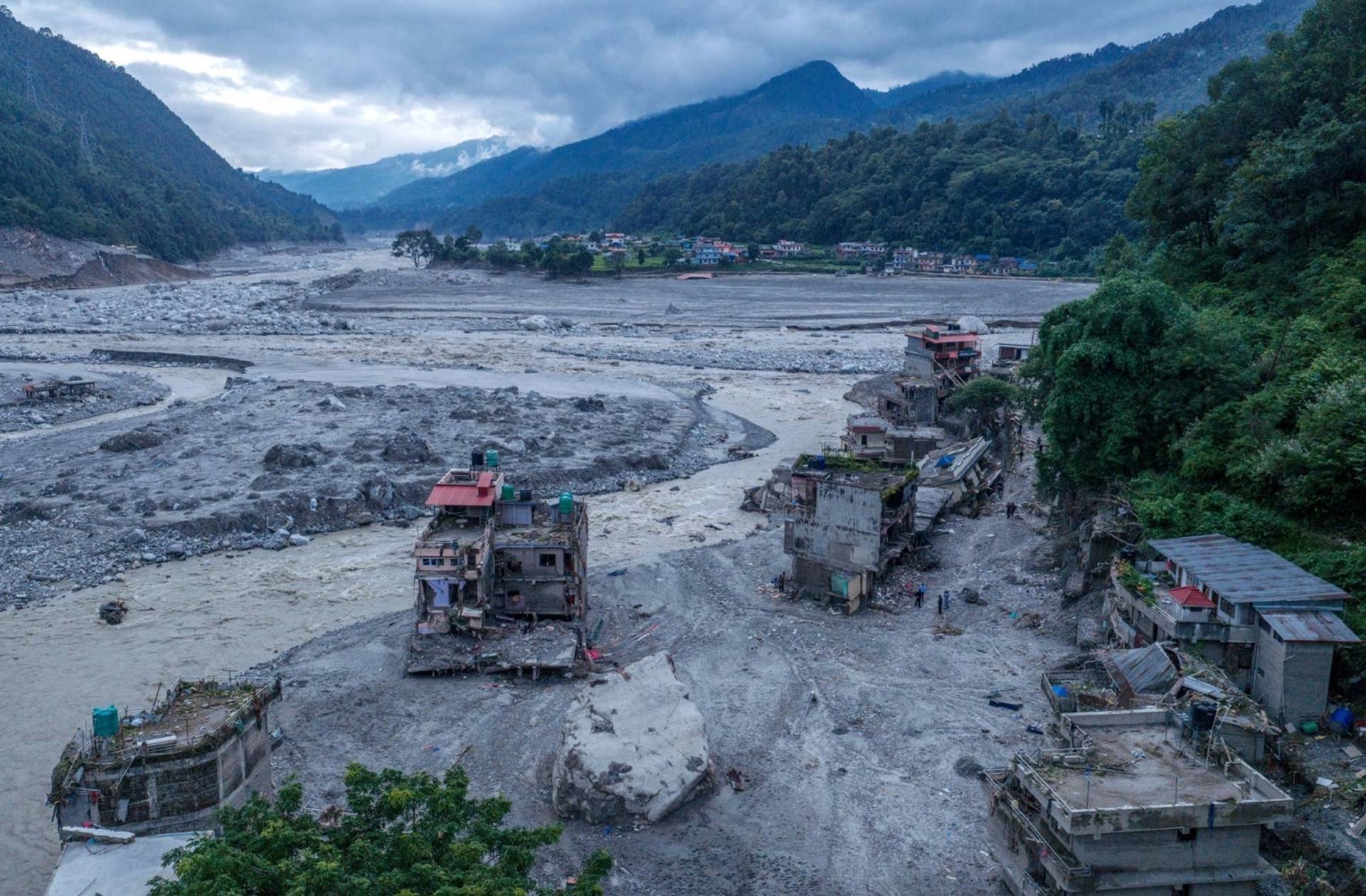
Three weeks after a wall of water, mud, and ice tore down the Bhote Koshi river valley, Nepal is still counting. Not counting recovery, not counting rebuilding — counting the missing. On September 15, the country’s Department of Tourism delivered a number that, on its own, tells a story more haunting than almost any single statistic to emerge from the disaster so far: 607 foreign tourists from 34 different countries remain unaccounted for.
The catastrophe began on August 26, when a glacial collapse in the high Himalayas triggered a devastating flash flood that swept through communities in Nepal’s Rasuwa district and spilled across the border into China’s Tibet Autonomous Region. What followed was one of the deadliest natural disasters to strike the region in recent memory, with the death toll climbing past 1,100 people in the disaster’s immediate aftermath and thousands more initially reported missing as search-and-rescue teams struggled to reach areas where roads, bridges, and entire settlements had simply been erased.
The specific figure released this week carries its own grim texture. According to information officer Suraj Ghimire of the Department of Tourism, the missing foreign nationals — 269 men, 329 women, and nine individuals not yet identified — had largely been traveling along two of the region’s most storied pilgrimage and trekking routes: toward Kailash Mansarovar in Tibet, one of the most sacred sites in Hindu, Buddhist, and Jain tradition, and toward Gosaikunda and Mustang, both popular high-altitude trekking destinations. Many were reportedly traveling during Janai Purnima, a Hindu festival that draws pilgrims to high-altitude lakes considered sacred, a detail that helps explain why so many international visitors were concentrated in the flood’s path at the moment it struck.
The scale of the ongoing search effort reflects just how catastrophic the initial event was. Nepal Police have deployed thousands of personnel to search-and-rescue operations, a mobilization that has included not just ground teams but increasingly creative logistical workarounds necessitated by the flood’s destruction of basic infrastructure. With roads and suspension bridges washed away across the Aamachhodingmo rural municipality, authorities have turned to commercial drones capable of carrying meaningful payloads to transport emergency relief supplies into isolated, flood-cut-off communities — a striking illustration of how thoroughly the disaster severed conventional transportation routes across the affected region.
The recovery effort’s human toll extends beyond the missing themselves. Nepal Police reported that of the roughly 7,900 personnel deployed to search-and-rescue work, dozens have themselves been affected by the operation’s hazards, with some remaining out of contact during search operations in treacherous, unstable terrain. Recovery teams have also conducted well over 100 public awareness programs reaching tens of thousands of participants, part of a broader effort to help affected communities navigate both the practical and psychological aftermath of a disaster whose scale continues to defy easy comprehension.
Financially, the reckoning has proven staggering. Nepali officials have estimated the country now faces a recovery bill of roughly Rs 723 billion — a figure that, for a country of Nepal’s size and economic capacity, represents an almost unfathomable burden, one that will likely require significant international assistance to address. That estimate covers not just the human search-and-rescue costs but the broader work of rebuilding roads, bridges, and infrastructure across an area where, as officials have noted, ground transportation was completely severed by the initial flooding and subsequent secondary flood events in the weeks that followed.
The political fallout has been its own parallel story. Domestically, opposition figures have used the disaster to sharpen long-standing critiques of the government’s disaster preparedness. Ujyalo Nepal Party President Kulman Ghising, speaking publicly in Lalitpur, argued that more proactive emergency planning and earlier disaster warnings could have significantly reduced civilian casualties — criticism that arrives against the backdrop of broader youth-led political discontent that has simmered in Nepal in recent months, adding another layer of pressure on an administration already stretched thin managing the disaster response itself.
Internationally, the flood drew attention specifically to the fate of foreign visitors, a detail that has kept the story in headlines well beyond Nepal’s own borders. Early in the search effort, foreign governments — including Australia’s, whose prime minister publicly confirmed several previously missing citizens had been found safe — provided periodic updates on their own nationals, treating the disaster with the kind of sustained diplomatic attention typically reserved for events with significant international casualties. That attention has not entirely faded three weeks on, even as domestic Nepali news coverage has necessarily broadened to cover the disaster’s economic and political ripple effects alongside the ongoing search.
As of this week, with 607 foreign nationals still unaccounted for and the overall search effort continuing, Nepal’s flood disaster occupies an uncomfortable middle ground between acute crisis and prolonged recovery. The most intensive search-and-rescue window — the period during which survivors might realistically still be found — has almost certainly closed for most of those still missing, a grim reality search teams are unlikely to state plainly even as their operational posture inevitably shifts toward recovery of remains rather than rescue of survivors. What remains is the slow, painstaking work of accounting for the missing, rebuilding shattered infrastructure, and reckoning with a recovery bill that will shape Nepal’s fiscal priorities for years to come.





0 Comments