

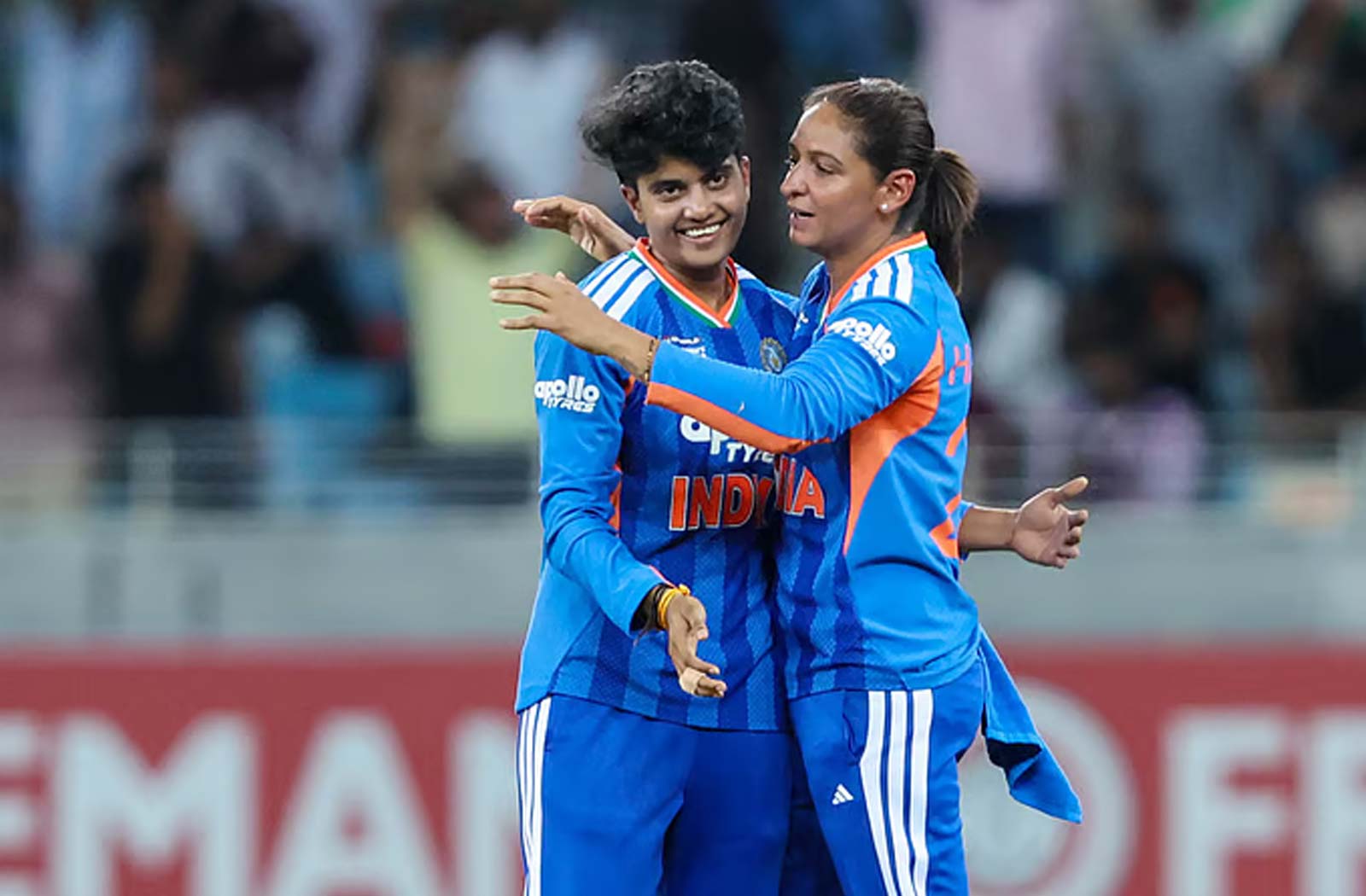
“Fifty-Five and Out: India’s Bowlers Humble Pakistan in Historic Asia Cup Rout”
In one of the most one-sided contests in the history of India-Pakistan women’s cricket, India dismantled Pakistan for a record-low total of 55 runs before cruising to a seven-wicket win in their Women’s Asia Cup 2026 league finale at the Dubai International Cricket Stadium on September 5. India bowled Pakistan out for a record-low score of 55 before sealing a seven-wicket win to top Group A and qualify for the Women’s Asia Cup 2026 semi-finals.
The result was as much about India’s bowling discipline as it was about Pakistan’s batting collapse. Prema Rawat and Shree Charani, two of India’s frontline bowlers, were the chief architects of the demolition. Prema Rawat and Shree Charani claimed three wickets each, as Pakistan were bundled out for only 55 runs. Pakistan’s innings never found any rhythm, with wickets tumbling in clusters as India’s seamers and spinners combined to strangle any hope of a recovery.
Fatima Sana, Pakistan’s captain, offered a brief moment of resistance with the ball when her side later took to the field, but it was too little to change the course of the match. Fatima Sana briefly gave Pakistan something to cheer about, also removing Pratika Rawal for four and Smriti Mandhana for nine to leave India 29/3 after four overs. Sana’s individual bowling figures were impressive under the circumstances — the Pakistan captain finished with all three Indian wickets, returning 3/17 — but with such a paltry target to defend, even a strong bowling display could not stem the tide.
India’s chase, while briefly shaky, was steered home comfortably by captain Harmanpreet Kaur and the dependable Deepti Sharma. However, with the required rate never a concern, Harmanpreet and Deepti calmly took India towards the target. Harmanpreet then provided the emphatic finish, striking a four before launching the next delivery over long-on for six to complete the seven-wicket victory in style.
Beyond the result itself, the match produced a landmark individual achievement. Young opener Shafali Verma etched her name into the record books during the contest. During her innings, Shafali became the youngest woman to reach 3000 runs in T20I cricket, reaching the milestone at the age of 22 years and 220 days. The milestone underscored Shafali’s rapid rise as one of the format’s most destructive young talents, and it came at a fitting moment — in the biggest rivalry match of the tournament.
The context leading into the fixture only added to its drama. India arrived at the contest with strong momentum, having posted big wins earlier in the competition, while question marks lingered over parts of their batting order. Pakistan, by contrast, had played sparingly in the tournament before this clash. The Harmanpreet Kaur-led side arrives for the high-voltage clash following mammoth wins over Thailand and Hong Kong, China. However, there are some concerns regarding their batting unit. On the other side, Pakistan, on the other hand, have played only one match so far in the competition. They defeated Thailand by 35 runs after keeper Muneeba Ali scored a half-century.
The occasion also carried historical significance for India’s captaincy setup. India’s Harmanpreet Kaur is set to become the first captain ever to lead in 150 T20Is. No one has achieved the feat in men’s T20Is either. It was a fitting backdrop for a leader who has anchored India’s white-ball resurgence over the past several years, even though, as commentators noted at the time, the veteran has been very quiet so far in the Asia Cup with the bat.
Meanwhile, Smriti Mandhana’s form heading into the fixture had already been generating headlines. Star India opener Smriti Mandhana broke two world records in the previous clash against Hong Kong, China. combining with Shafali to give India’s top order some much-needed firepower, even if Mandhana herself fell early in this particular chase.
For Pakistan, the defeat was a sobering reminder of the gulf that still exists between the two sides in the women’s game, especially in high-pressure knockout-adjacent fixtures. For India, the win was a statement of intent — not just about beating their fiercest rivals, but about doing so with such emphatic dominance that it set the tone for their eventual march to the title. The result confirmed India’s position at the top of Group A and set up their path toward the final, where they would go on to lift the trophy just over a week later.
As tournaments like the Asia Cup continue to draw massive attention across South Asia, matches like this one reaffirm why India-Pakistan women’s cricket has become one of the most closely watched rivalries in the sport — even when the contest itself turns into a rout.






0 Comments