

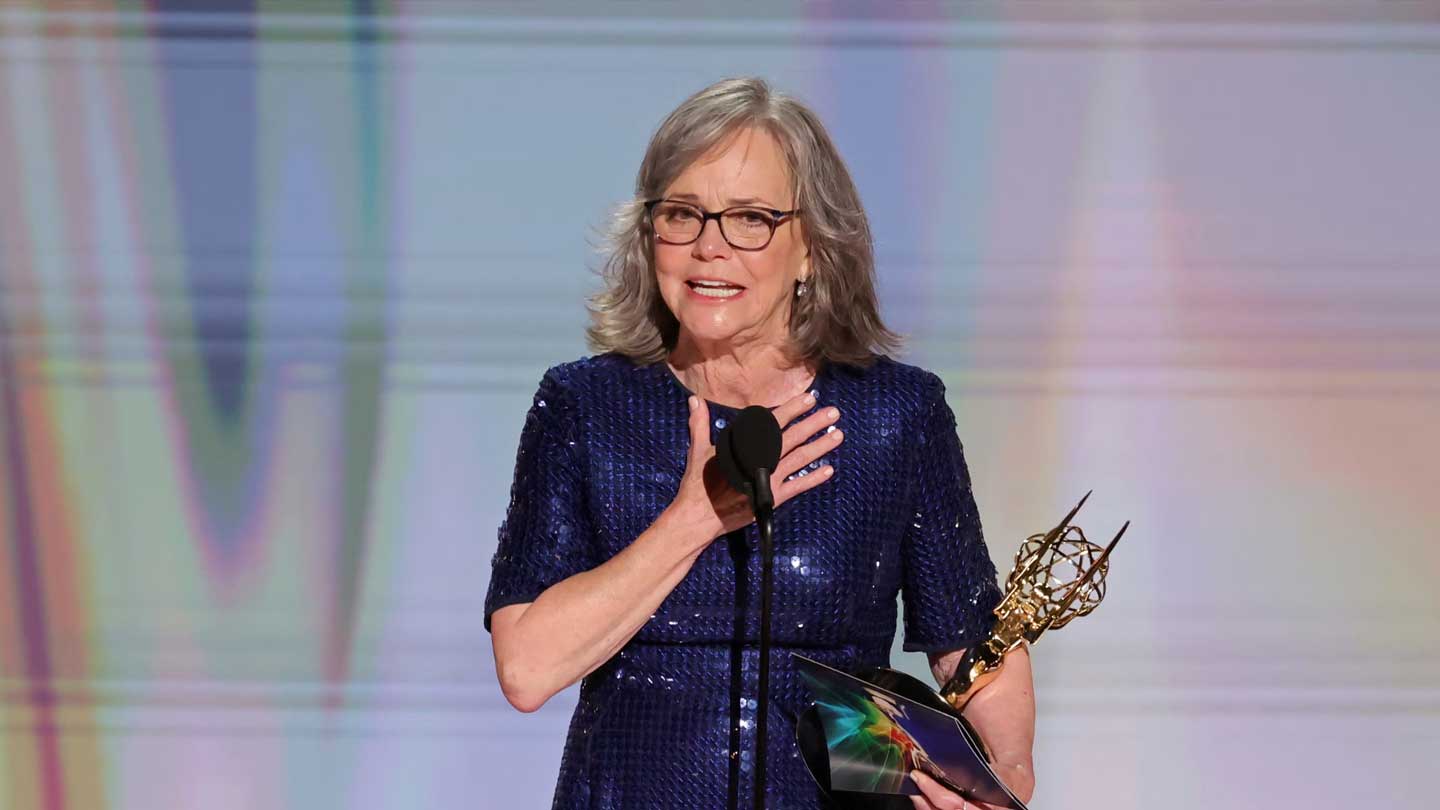
Awards show speeches are, more often than not, forgotten within days — a blur of thank-yous to agents, co-stars, and family members. Sally Field’s acceptance speech at this year’s Primetime Emmy Awards was not one of those speeches. In a matter of sentences, the 79-year-old actress turned a routine moment of industry recognition into a pointed commentary on the state of U.S.-Canada relations and the ongoing consolidation of the American media industry.
Field won the award for Outstanding Lead Actress in a Limited or Anthology Series or Movie for her role in the Netflix drama “Remarkably Bright Creatures,” becoming the oldest winner in that category’s history. The film, adapted from a bestselling novel, follows the bond between a widowed aquarium worker and a young musician, and was notably shot on location in British Columbia rather than in the United States — a detail that Field made central to her remarks.
Accepting the trophy, Field took a moment to specifically thank the film’s Canadian production setting, describing the country in warm, deliberately pointed terms as the audience offered an enthusiastic response. The comment landed squarely within an ongoing and increasingly tense backdrop: escalating trade friction between the United States and Canada, driven in large part by the current U.S. administration’s tariff policies and its explicit push for Hollywood productions to return to domestic soil rather than continuing to film abroad, including in Canada.
By choosing to highlight the Canadian setting of her award-winning project at exactly this political moment, Field effectively used her platform to push back — subtly but unmistakably — against a policy direction she and much of the industry apparently view as damaging both to cross-border creative relationships and to the practical realities of film production, where Canadian tax incentives and skilled crews have long made the country an attractive filming location for American studios.
Field did not stop there. Her speech also addressed a second, related anxiety rippling through Hollywood: the pending merger between Paramount and Warner Bros. Discovery, a deal that has drawn scrutiny from creative unions and antitrust critics alike over concerns about industry consolidation, job losses, and the narrowing of diverse storytelling perspectives across major media companies. Field argued forcefully that the arts and the voices within them mattered too much to be, in her words, silenced, compromised, or merged away — a direct swipe at the scale of the proposed deal and what it might mean for creative independence going forward.
The moment did not occur in isolation. Earlier in the same ceremony, “The Traitors” host Alan Cumming had used his own acceptance speech to urge American viewers to register to vote ahead of the fall midterm elections, signaling that this year’s Emmys, hosted by Mariska Hargitay, were shaping up to be more overtly political than in recent memory — a reflection, perhaps, of an industry increasingly willing to use its highest-profile platforms to comment on issues it sees as existential to its own future.
The ceremony carried additional emotional and symbolic weight tied to Canada specifically. Edmonton-born actor Michael J. Fox was honored with the Bob Hope Humanitarian Award, introduced pointedly as a “proud son of Canada,” recognizing decades of advocacy for Parkinson’s disease research following his own diagnosis in 1991. Meanwhile, the ceremony’s In Memoriam segment included an extended, emotional tribute to Canadian actress and comedian Catherine O’Hara, who died earlier this year at 71. Actors including Macaulay Culkin, Annie Murphy, and Dan Levy — all connected to her through projects spanning decades of her career — paid homage to her legacy, describing her influence on generations of comedic performers.
Taken together, the ceremony’s repeated invocations of Canada — through Field’s speech, Fox’s humanitarian honor, and the tribute to O’Hara — created an unmistakable throughline for an awards show taking place against the backdrop of genuine diplomatic and economic strain between the two countries. Media coverage in both the U.S. and Canada seized on the moment, with Canadian outlets in particular framing Field’s remarks as a rare instance of a major American celebrity using an internationally broadcast platform to explicitly push back against the administration’s rhetoric toward its northern neighbor.
For an industry navigating its own internal upheavals — from the Paramount-Warner Bros. Discovery merger to broader questions about where and how content gets made — Field’s speech captured something larger than a single actress’s political opinion. It reflected a moment in which Hollywood’s biggest stars appear increasingly willing to blend personal acceptance speeches with broader commentary on the forces reshaping their industry, whether those forces come from Washington’s trade policy or the boardrooms overseeing entertainment’s next wave of consolidation.



0 Comments