

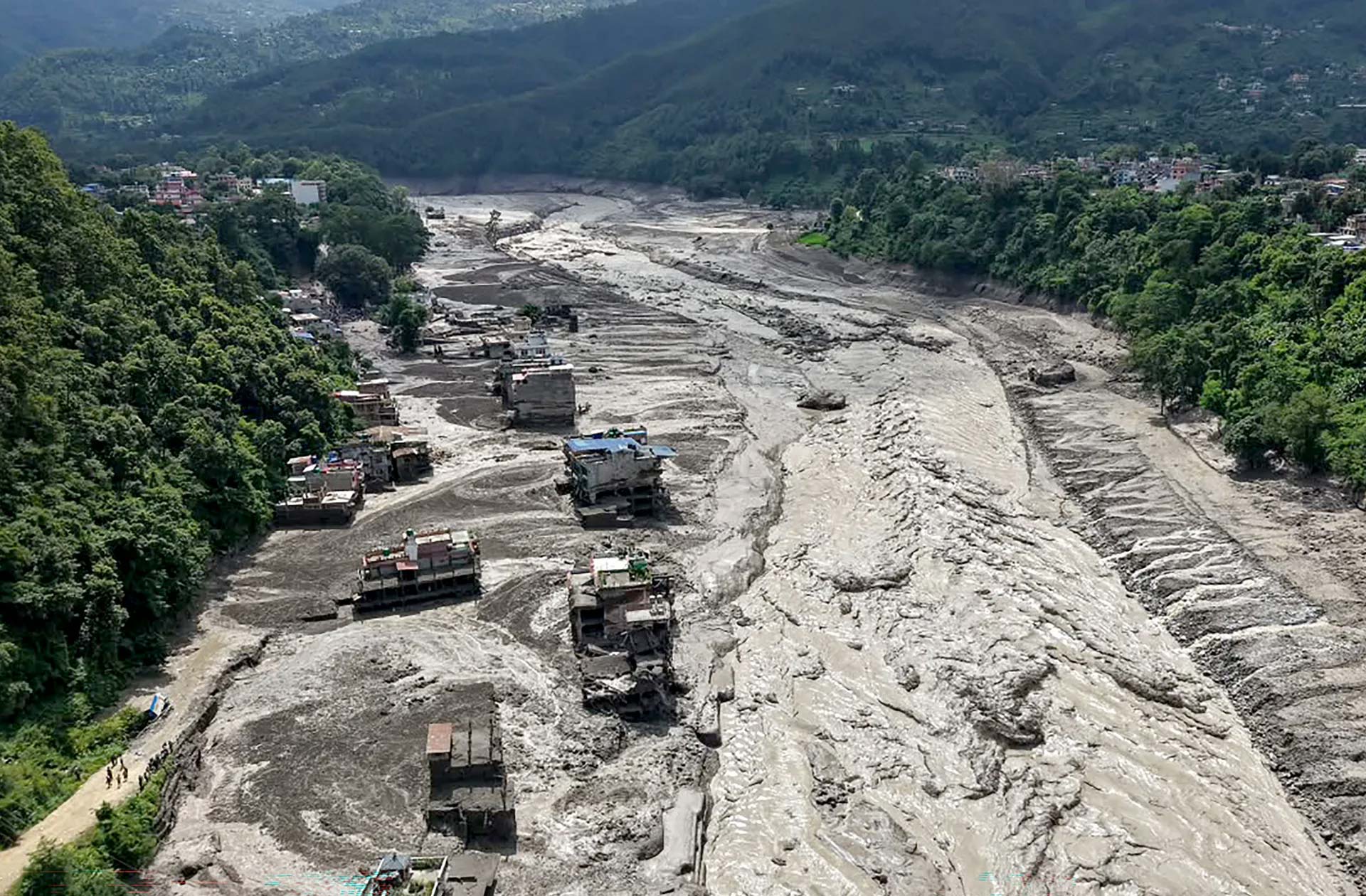
Three weeks after a glacial collapse sent a wall of water tearing through Nepal’s Bhote Koshi river valley, the country’s public health system finds itself confronting a second, slower-moving crisis layered on top of the acute catastrophe that made global headlines in late August. With 607 foreign tourists still missing as of this week’s official count and a recovery bill estimated at roughly Rs 723 billion, Nepal’s health authorities are now managing an increasingly complex set of public health challenges that extend well beyond the immediate work of search and rescue.
The flood itself, triggered by a glacial collapse high in the Himalayas on August 26, killed more than 1,100 people in its immediate aftermath and devastated infrastructure across Nepal’s Rasuwa district before spilling across the border into China’s Tibet Autonomous Region. In the weeks since, the scale of destruction has forced Nepal’s public health response to operate across multiple overlapping fronts simultaneously: continuing search operations for the missing, managing the health needs of displaced survivors, guarding against secondary disease outbreaks in flood-affected communities, and beginning the much longer process of addressing the psychological toll the disaster has taken on everyone it touched.
Disease risk represents one of the most immediate and well-understood public health concerns following any major flooding disaster, and Nepal’s situation carries particular complications given the disaster’s high-altitude, difficult-to-access location. Flooding disrupts normal water and sanitation infrastructure, creating conditions where waterborne illnesses like cholera, typhoid, and various forms of gastroenteritis can spread rapidly through affected populations, particularly in areas where clean water access was already limited before the disaster struck. With roads and bridges washed away across large portions of the affected Aamachhodingmo rural municipality, ensuring that displaced communities have access to clean water and basic sanitation has become an acute logistical challenge, compounding the more visible crisis of physical destruction and loss of life.
Nepal Police, which has deployed thousands of personnel to search-and-rescue operations, has increasingly turned to unconventional logistical solutions to address these overlapping challenges, including the use of commercial drones capable of carrying meaningful payloads to transport emergency relief and medical supplies into communities that remain cut off from conventional ground transportation routes. That kind of improvised logistics — necessitated by infrastructure destruction so severe that even routine humanitarian relief delivery has required creative workarounds — illustrates just how comprehensively the disaster has strained Nepal’s ability to deliver basic public health services to affected populations.
The mental health dimension of the disaster’s aftermath has received less public attention than the search for missing persons, but public health officials and aid organizations working in the region have emphasized its importance as recovery efforts continue. Communities that have lost family members, watched their homes and livelihoods destroyed, and now face months or years of rebuilding carry a psychological burden that, left unaddressed, can compound the disaster’s long-term public health impact well beyond its immediate physical toll. Reports indicate that recovery teams have conducted well over 100 public awareness programs reaching tens of thousands of participants across affected areas, part of a broader effort to help communities navigate both the practical and emotional aftermath of a disaster whose scale continues to defy easy comprehension even three weeks on.
The disaster’s public health toll has extended to responders themselves. Of the roughly 7,900 personnel Nepal Police has deployed to search-and-rescue operations, some have themselves been affected by the hazards inherent to working in unstable, flood-damaged terrain, with reports of personnel remaining out of contact during search operations in particularly treacherous conditions — a reminder that disaster response work carries its own significant occupational health and safety risks, particularly in a high-altitude environment where terrain instability and ongoing secondary flooding events have complicated recovery work throughout the weeks since the initial disaster.
Domestically, the disaster’s public health and humanitarian response has become entangled with broader political criticism of Nepal’s disaster preparedness infrastructure. Opposition political figures, including Ujyalo Nepal Party President Kulman Ghising, have argued publicly that more proactive emergency planning and earlier disaster warning systems could have significantly reduced both the initial casualties and the subsequent strain on the country’s health and humanitarian response capacity — criticism that arrives against the backdrop of broader political tensions that have simmered in Nepal in recent months, adding political pressure to an administration already stretched thin managing an enormously complex, multi-front disaster response.
Internationally, the involvement of foreign governments in monitoring the fate of their own citizens among the missing has added another dimension to the response, with countries including Australia providing periodic updates on the status of their nationals throughout the search effort. That international dimension has helped keep global attention focused on Nepal’s ongoing crisis even as domestic coverage has necessarily broadened to encompass the disaster’s economic, political, and public health ripple effects alongside the continuing search for the missing.
As Nepal moves further into the recovery phase of this disaster, the public health challenges ahead are likely to prove, in some respects, more protracted and less visible than the dramatic search-and-rescue operations that dominated headlines in the disaster’s immediate aftermath. Waterborne disease risk, mental health needs, and the sheer logistical challenge of rebuilding health infrastructure across a vast, difficult terrain will likely shape Nepal’s public health landscape for months or years to come — a slower, less headline-grabbing crisis, but one that will ultimately determine how fully the communities devastated by August’s flood are able to recover.





0 Comments