

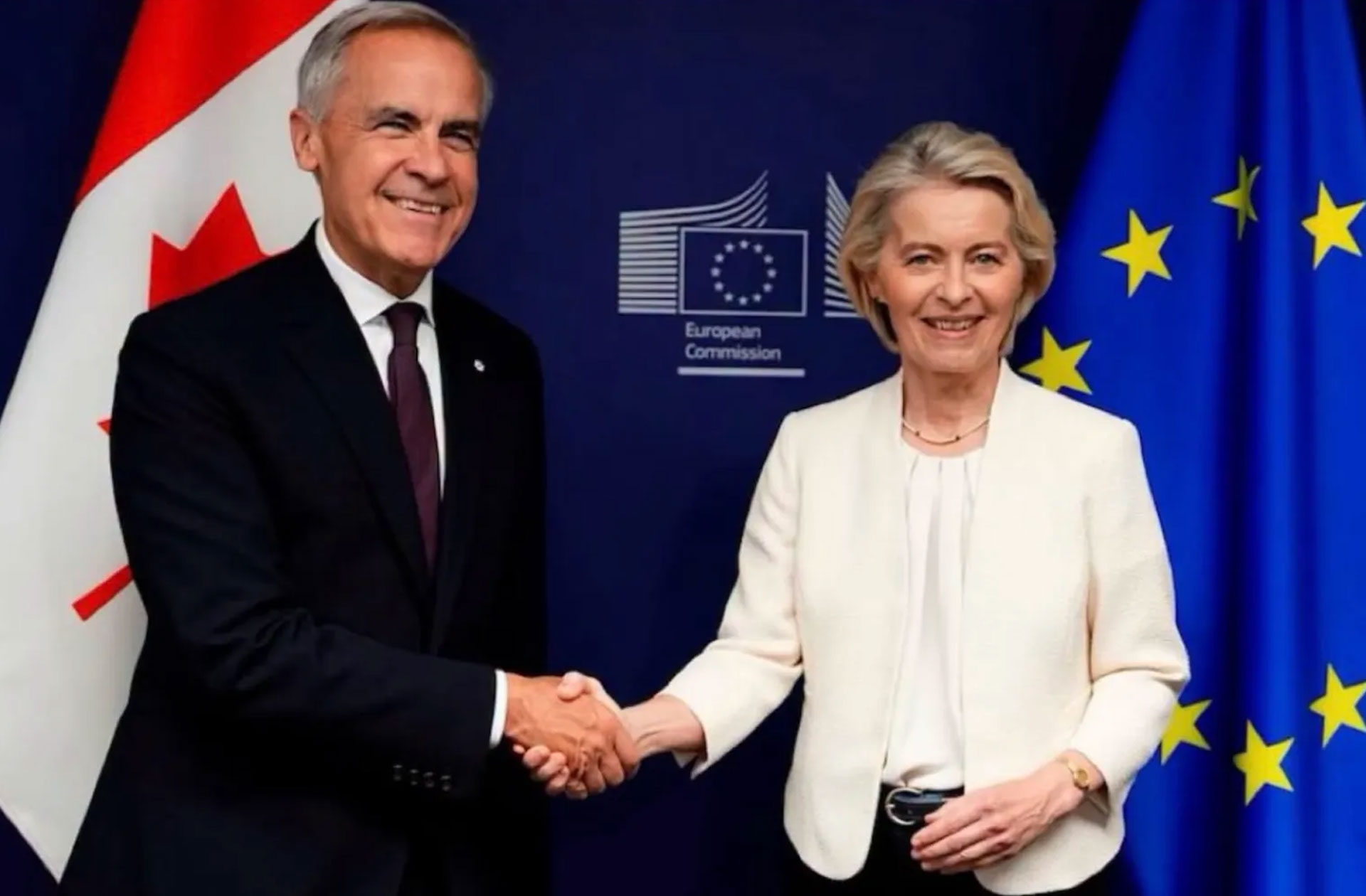
For nearly six decades, membership in the European Union has meant one thing: you had to be European. On September 16, that assumption cracked. Standing before the European Parliament in Strasbourg, European Commission President Ursula von der Leyen looked out at an audience that included Canadian Prime Minister Mark Carney and made history, proposing that Canada become the EU’s first-ever “associate member.”
The announcement came during von der Leyen’s annual State of the Union address, one of the most closely watched speeches on the European political calendar. According to reporting from NPR, the line inviting Canada to “associate member” status wasn’t even in her prepared remarks as originally circulated — she added it, and the chamber responded with a standing ovation. Von der Leyen and Carney reportedly exchanged the traditional cheek-kiss greeting as the applause continued, a moment that instantly became the defining image of the day.
What exactly does “associate membership” mean? That’s the question nobody in Strasbourg could fully answer. It’s an entirely new category, without precedent in EU history. Existing models for close-but-not-full EU relationships include the European Economic Area (used by Norway, Liechtenstein, and Iceland) and the European Free Trade Association, which also includes Switzerland. Those arrangements grant deep access to the EU’s internal market but no vote on the rules that govern it. Whether Canada’s proposed status would include voting rights in EU institutions remains an open question — one that will likely take months, if not years, of negotiation to resolve.
Notably, the concept of “associate membership” isn’t entirely new to European diplomatic conversation. German Chancellor Friedrich Merz floated a similar idea back in May for Ukraine, a country desperate for full EU accession but blocked by the practical realities of an ongoing war. That Canada — a wealthy, stable G7 nation with no geographic claim to being European at all — is now the one being offered this unprecedented status says less about Canada’s proximity to Europe and everything about the state of its relationship with the United States.
Indeed, the timing is impossible to separate from the trade war raging between Ottawa and Washington. Since late August, Canada and the U.S. have been locked in an escalating tariff conflict, with retaliatory duties hitting sectors from steel to wine to hockey equipment. Canada has spent the weeks since aggressively courting new partners, and Europe, watching President Donald Trump’s trade brinkmanship with its own allies, appears eager to oblige. Von der Leyen framed the overture as an evolution of the existing EU-Canada Comprehensive Economic and Trade Agreement (CETA), which already eliminated the vast majority of tariff lines between the two economies when it took effect in 2017. “We will move from CETA to an alliance for the future,” she told the chamber, describing a partnership built around shared prosperity and economic security.
The scope being discussed goes well beyond trade. Euronews reported that negotiators are already exploring bringing Canada into the EU’s Erasmus+ exchange program, the bloc’s flagship initiative for student mobility, worth roughly $30 billion and used by millions of young Europeans each year. Talks are also reportedly underway on integrating Canada into Horizon Europe, the EU’s massive research funding vehicle, and on mutual recognition of professional qualifications — the kind of granular, practical policy work that would make it dramatically easier for Canadian engineers, doctors, and academics to work across the Atlantic.
Von der Leyen was careful to stress that the invitation to Canada wasn’t intended as a provocation. “This is not against anyone,” she reportedly told the assembled lawmakers — a line that, given the context, only underscored who exactly she wasn’t naming. President Trump did not extend the same diplomatic courtesy. Speaking to reporters after a campaign rally in North Carolina that evening, Trump dismissed the idea outright, calling it laughable.
For Carney, the moment represents the culmination of a strategic pivot that began almost as soon as trade talks with Washington collapsed in August. The prime minister has said repeatedly since taking office that Canada’s old assumptions about its relationship with the United States no longer hold, telling Canadians that the era of deep economic and security integration between the two countries “is over.” Wednesday’s speech in Strasbourg gave that rhetoric its first concrete counterweight: a real, if still undefined, alternative path forward.
Still, plenty of obstacles remain before “associate membership” becomes anything more than a proposal. The EU’s 27 member states will need to weigh in, and some are reportedly wary of provoking further anger from Washington. Legal scholars and trade experts note that formalizing a wholly new membership tier could take years of technical negotiation — treaty language would need to be drafted, ratification processes triggered in dozens of national parliaments, and thorny questions about voting rights, budget contributions, and regulatory alignment hammered out one by one.
For ordinary Canadians, the practical effects — if any ever materialize — are still a long way off. But symbolically, the offer lands at a moment when Canada’s sense of its own place in the world is visibly shifting. A country that spent 150 years defining its foreign policy in large part by its relationship with its southern neighbour is now being courted, publicly and enthusiastically, by an entirely different continent. Whatever comes of the technical negotiations ahead, September 16, 2026, will likely be remembered as the day that shift became impossible to ignore.






0 Comments