

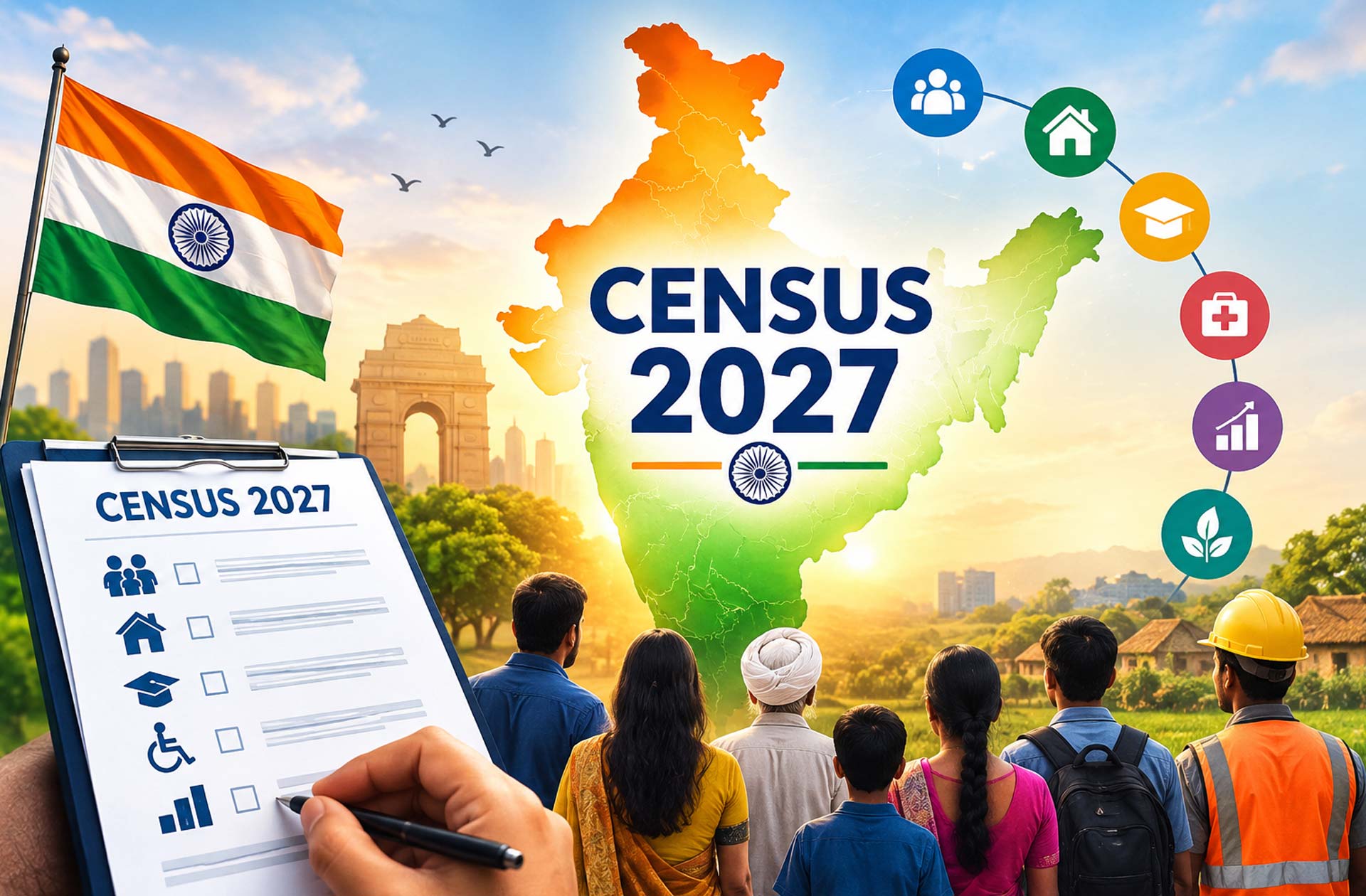
India’s next national census — a logistical undertaking of almost unimaginable scale even by the standards of a country accustomed to organizing the world’s largest elections — reached a significant new milestone this week, as officials confirmed the rollout of its second phase across Uttar Pradesh, Punjab, Goa, and the remaining portions of Uttarakhand, following completion of population enumeration in Ladakh, Himachal Pradesh, Jammu and Kashmir, and the initial phase of Uttarakhand itself.
What sets this census apart from every one of its predecessors isn’t simply its scope, but its method. For the first time in the country’s history, India’s Census 2027 is being conducted entirely through a digital process, with enumerators recording data directly through a dedicated mobile application on their personal smartphones rather than the paper-based forms that have defined every previous national headcount since India’s first census under British colonial administration in the nineteenth century. The shift represents one of the most significant modernizations of India’s statistical infrastructure in decades, carrying implications not just for how quickly data can eventually be processed and analyzed, but for the accuracy and granularity of the information collected in the first place.
The digital rollout follows a carefully sequenced two-phase structure. The first phase, known as House Listing Operations, began on April 1 and is scheduled to conclude by September 30, focused on cataloguing housing units, structures, and basic household information across the country before the more detailed Population Enumeration phase begins layering in demographic, social, and economic data about individual residents. That sequencing — first mapping the physical housing landscape, then populating it with detailed information about the people living within it — mirrors the traditional structure of Indian census operations, even as the underlying technology used to execute each phase has been completely overhauled.
Perhaps the most operationally significant innovation embedded in this year’s approach is what officials have termed “self-enumeration” — an option allowing enumerators themselves to complete census forms for their own households through the same Population Enumeration Mobile App used in their professional duties. Official guidance has explicitly encouraged this practice, reasoning that direct, hands-on experience answering the census’s own questions will better acquaint enumerators with the substance of what they’ll be asking millions of other households in the months ahead. Correspondingly, hands-on practice with the mobile application has been made mandatory for all enumerators and supervisors involved in the rollout, reflecting an evident institutional recognition that a fully digital census depends entirely on frontline personnel who are genuinely comfortable navigating the technology, not merely trained on it in the abstract.
The geographic sequencing of this year’s rollout carries its own significance. Beginning enumeration in Ladakh, Jammu and Kashmir, Himachal Pradesh, and Uttarakhand — several of which include remote, high-altitude, and historically difficult-to-access terrain, along with Jammu and Kashmir’s particular administrative and security sensitivities — before moving into the far more densely populated plains of Uttar Pradesh and Punjab suggests a deliberate strategy of tackling logistically complex regions early, potentially to work through technical and procedural challenges specific to difficult terrain before scaling the digital process up to India’s most populous states. Uttar Pradesh alone is home to more than 200 million people, making its accurate and timely enumeration arguably the single most consequential technical challenge the entire census exercise will face.
The stakes extend well beyond simple population counting. India’s census data underpins an enormous range of policy decisions, from the allocation of parliamentary constituencies and government funding formulas to targeting for social welfare programs and infrastructure planning. The country’s previous census, conducted in 2011, has increasingly strained under its own obsolescence as India’s population has grown and shifted in the subsequent decade and a half — a gap made only more consequential by the fact that India’s originally scheduled 2021 census was delayed repeatedly, first by the COVID-19 pandemic and subsequently by a series of administrative postponements, leaving policymakers reliant on aging data even as the country’s demographic and economic landscape has transformed considerably since the last accurate national count.
As the digital census now moves into some of India’s most populous and politically significant states, the coming months will offer the clearest test yet of whether the country’s ambitious bet on a fully app-based enumeration process can deliver on its promise of faster, more accurate, and more granular demographic data — or whether the sheer scale of counting well over a billion people will surface technical and logistical challenges that no amount of mandatory app-training can fully anticipate.




0 Comments