

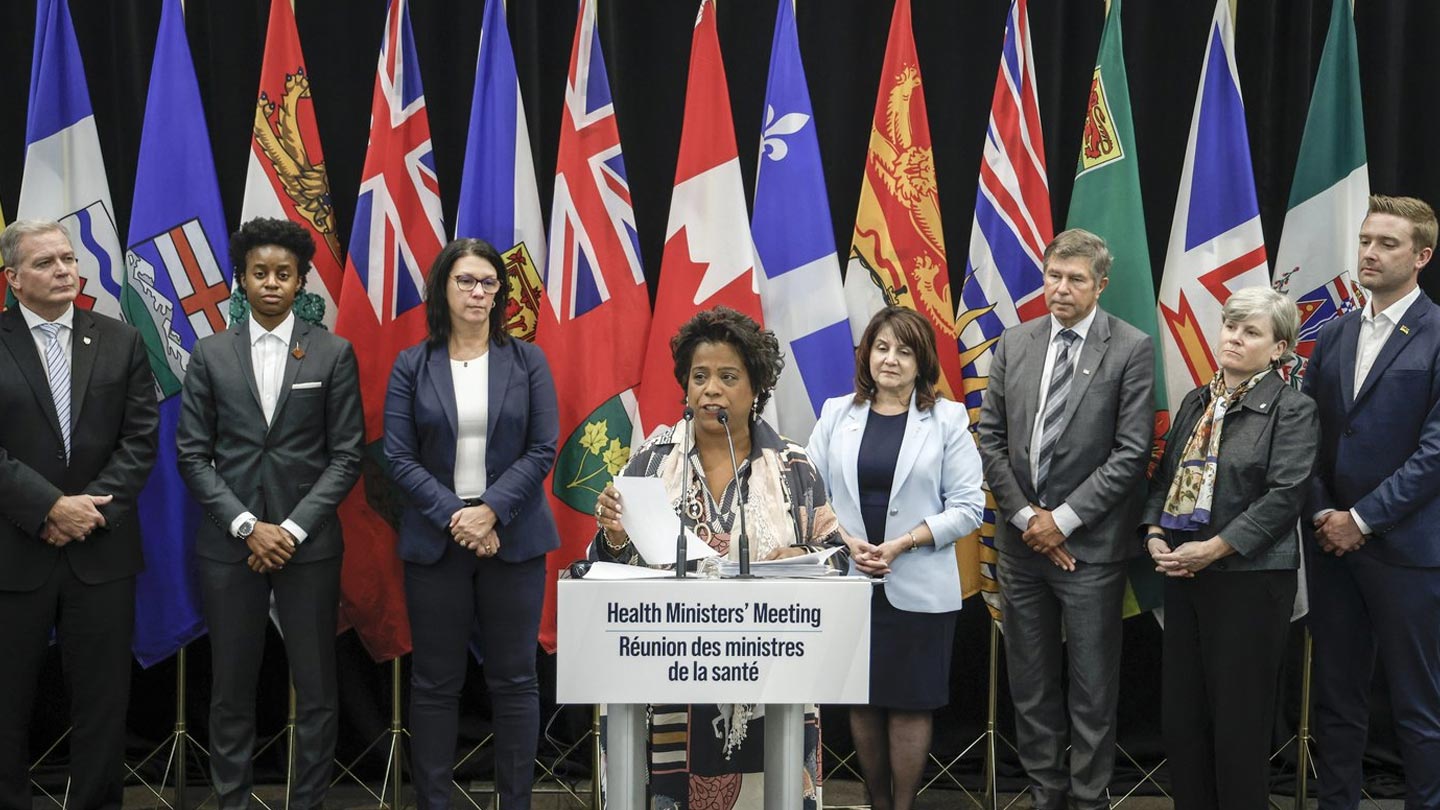
WINNIPEG – Canada’s health ministers got something they had been asking for: more time. They did not get certainty, and on that point they spoke with one voice.
Federal Health Minister Marjorie Michel announced late on Wednesday, October 14, that Ottawa would extend funding for mental health, addictions and home care by one year, a commitment worth $1.2 billion. The announcement came ahead of an in-person meeting of federal, provincial and territorial health ministers in Winnipeg. Provincial ministers had warned of “profound and negative” effects on patients and health-care jobs if the agreements were not renewed in this year’s budget.
The meeting took place on October 16 and was co-chaired by Michel and Manitoba Health Minister Uzoma Asagwara, with a news conference afterward. Coverage from The Canadian Press and CTV News described the ministers as united in demanding funding certainty even after the extension was confirmed. By the weekend, CTV was reporting that ministers believed the extension only delays a looming “fiscal cliff.”
The unease is not only about the next twelve months. Provinces and territories also raised concerns about the future of the Canada Health Transfer, since the federal budget says its minimum growth rate will drop to three per cent from five per cent in 2028. The transfer is the largest federal contribution to provincial health systems, so even a modest change in its growth floor compounds over time. Asagwara said the ministers spoke with Michel about their unanimous concerns and want to hear more about federal health funding.
Medical groups backed the provinces. On October 14, Canada’s doctors and nurses issued a statement standing with provinces and territories in calling for predictable, sustainable health-care funding. The Canadian Medical Association had launched a public campaign on October 6 to make health care a federal budget priority, and published a commentary on October 13 arguing that building a stronger Canada requires a stronger health system. The association says strong and reliable federal funding for universal health care is foundational to growing the economy.
For patients, the funding is concrete. Mental health, addictions and home care are the services that keep people out of emergency rooms and hospital beds. They include counselling for a young person in crisis, treatment spaces for someone fighting addiction, and a visiting care worker who lets a senior stay at home. These programs depend on staff whose jobs depend on stable money. A one-year extension keeps the lights on, but it makes it hard for provinces to recruit, sign multi-year contracts or expand services when the funding horizon is twelve months. That is the practical meaning of the ministers’ complaint, and it is a reasonable reading of why they described the extension as a delay rather than a solution.
The timing adds pressure. Respiratory-virus season is already under way, with Health Canada reporting 1,149 positive influenza detections in a single week and some provinces moving vaccine rollouts earlier. Home care and mental health services take up much of the slack when hospitals fill up, so any uncertainty about their funding lands at a sensitive moment.
Politically, the extension buys Ottawa room to settle its long-term health commitments, and it lets provinces keep services running while those talks continue. Both sides now face a clock. The ministers’ message after Winnipeg was that predictable funding has to arrive well before the extension runs out. Without it, they say, the same warnings about service cuts and lost jobs will come back next year, and with less time to respond.
What Canadians should watch for next is whether Ottawa moves from one-year patches to multi-year agreements, and whether it revisits the 2028 transfer formula. Michel and Asagwara’s meeting did not resolve either question. It did put on the record that every province and territory shares the concern, which makes it harder for the issue to be treated as a regional complaint.

0 Comments