

NEW DELHI / PATNA – A long-running dispute over India’s electoral rolls moved back to the centre of national politics this weekend, as Congress president Mallikarjun Kharge accused the Bharatiya Janata Party of manipulating voter lists and demanded the resignation of Chief Election Commissioner Gyanesh Kumar. The charge, made in Patna on Oct. 25, came as the BJP announced protests over a separate remark Kharge made at the same event, and as a fresh petition landed in the Supreme Court seeking an overhaul of the Election Commission itself.
Patna flashpoint
Kharge was speaking at a function marking the 139th birth anniversary of Bihar’s first chief minister, Shri Krishna Singh, when a heckler shouted in support of Prime Minister Narendra Modi. Kharge responded with a sharp Hindi retort, “Modi ka baap bhi jayega,” roughly, “even Modi’s father will go,” which quickly became a political controversy. The BJP announced a protest, and Union Home Minister Amit Shah criticized the Congress chief, according to Indian media reports. Business Today reported that the Patna event also exposed discontent within the Bihar Congress, with protests at the venue.
The row has partly overshadowed Kharge’s main accusation. He alleged that the BJP has manipulated electoral rolls and demanded that Gyanesh Kumar step down, pressing a theme the opposition has built its recent campaigns around.
The “SIR” dispute
The roots of the confrontation lie in the Election Commission’s Special Intensive Revision, or SIR, of voter lists. The exercise was announced for Bihar on June 24, 2025, ahead of that state’s assembly election. The commission told the Supreme Court that 99.5 per cent of the 72.4 million electors in the draft roll had submitted eligibility documents. A bench including Justices Surya Kant and Joymalya Bagchi heard challenges from the Rashtriya Janata Dal, the AIMIM, civil society groups and others, and the court directed the commission to let excluded voters file claims online in addition to physical submissions.
Since then, the government has extended the revisions across most Indian states. In an analysis published Oct. 24, TIME argued that the move risks turning voting from a constitutional right into something conferred at the discretion of officials. Retired Maj. Gen. Anil Verma, who heads the Association for Democratic Reforms, a nonprofit that challenged the revisions in the Supreme Court, told the magazine that most Bihar voters left off the list were in rural areas and that the worst affected were poor and marginalized people who lacked documents. Amit Shah, TIME noted, has described the protests against the exercise as an “action plan to protect infiltrators”, reflecting the government’s position that the revisions are needed to remove illegal migrants from the rolls.
Streets, students and a new petition
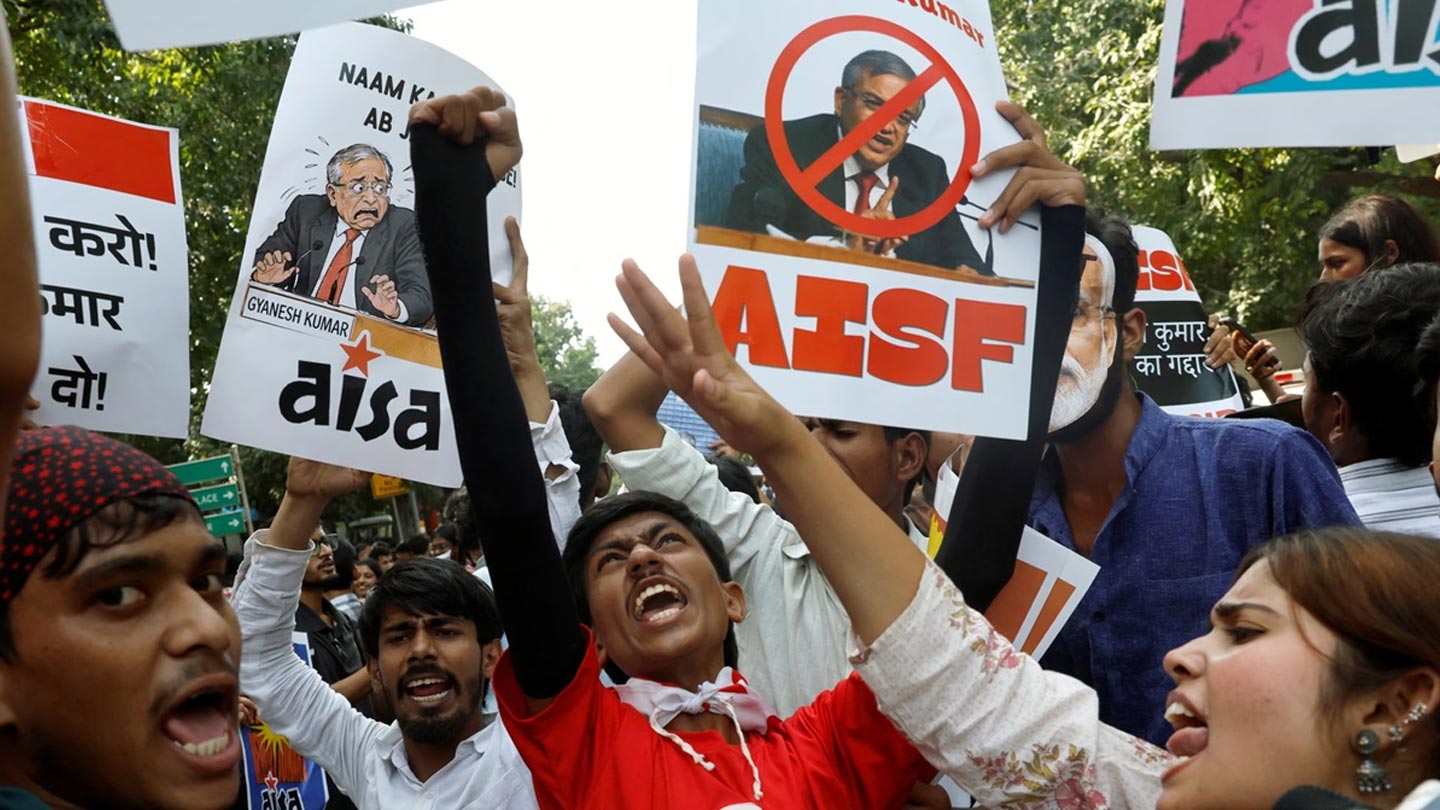
The dispute has driven street protests as well as courtroom battles. Earlier this year, a youth-led movement that styles itself with the nickname “cockroach” demanded the election chief’s resignation; its leaders were detained and later freed, according to South China Morning Post headlines, and police detained a student protester demanding the chief election commissioner’s removal in New Delhi. The movement remained visible this month, when a 30-foot cockroach effigy was burned alongside Ravana at a Delhi Dussehra event, according to Organiser.
On Oct. 25, advocate Vishal Tiwari filed a public interest litigation in the Supreme Court seeking an independent expert committee, chaired by a former Chief Justice of India or a former top court judge, to examine institutional deficiencies in the Election Commission. The petition also asks the court to bar religious identities, symbols, communal appeals and hate speech in election campaigns. Whether the court will take it up is not yet known.
Competing narratives
Supporters of the revision say a clean, accurate voter list is the foundation of a credible election and that removing duplicate, deceased and ineligible names is a routine duty of the commission. The commission has maintained that the process was transparent and that voters had multiple opportunities to submit claims. Critics counter that document requirements place the burden of proof on citizens, disproportionately affecting migrants, the poor, women and minorities who may lack paperwork, and that the speed and timing of the exercise left little room for correction.
The political stakes are high. Bihar, where Samrat Choudhary of the BJP has been chief minister since April, is a bellwether for northern India, and the opposition sees the voter-list issue as one of its few unifying causes. For the BJP, the issue offers a chance to frame the opposition as defending infiltrators, a charge that has long resonated with parts of its base.
What comes next
The immediate flashpoints are the BJP’s planned protests over Kharge’s remark, the fate of the new Supreme Court petition and the continued rollout of the revision in other states. Beyond the headlines, the underlying question is one that India’s democracy has faced before and will face again: how to keep voter lists accurate without shutting out the people they are meant to include. The answer, for now, is being fought out in rallies, hearings and hashtags rather than settled.
Who Gets to Vote? India’s Voter-List Battle Heats Up as Kharge Demands the Election Chief’s Exit
- October 26, 2026
- TSA News
Who Gets to Vote? India’s Voter-List Battle Heats Up as Kharge Demands the Election Chief’s Exit
Tag :
Search Post
Popular Posts



Follow Us
Follow us on social media and never miss the latest updates, trending news, and exclusive stories.
0 Comments