

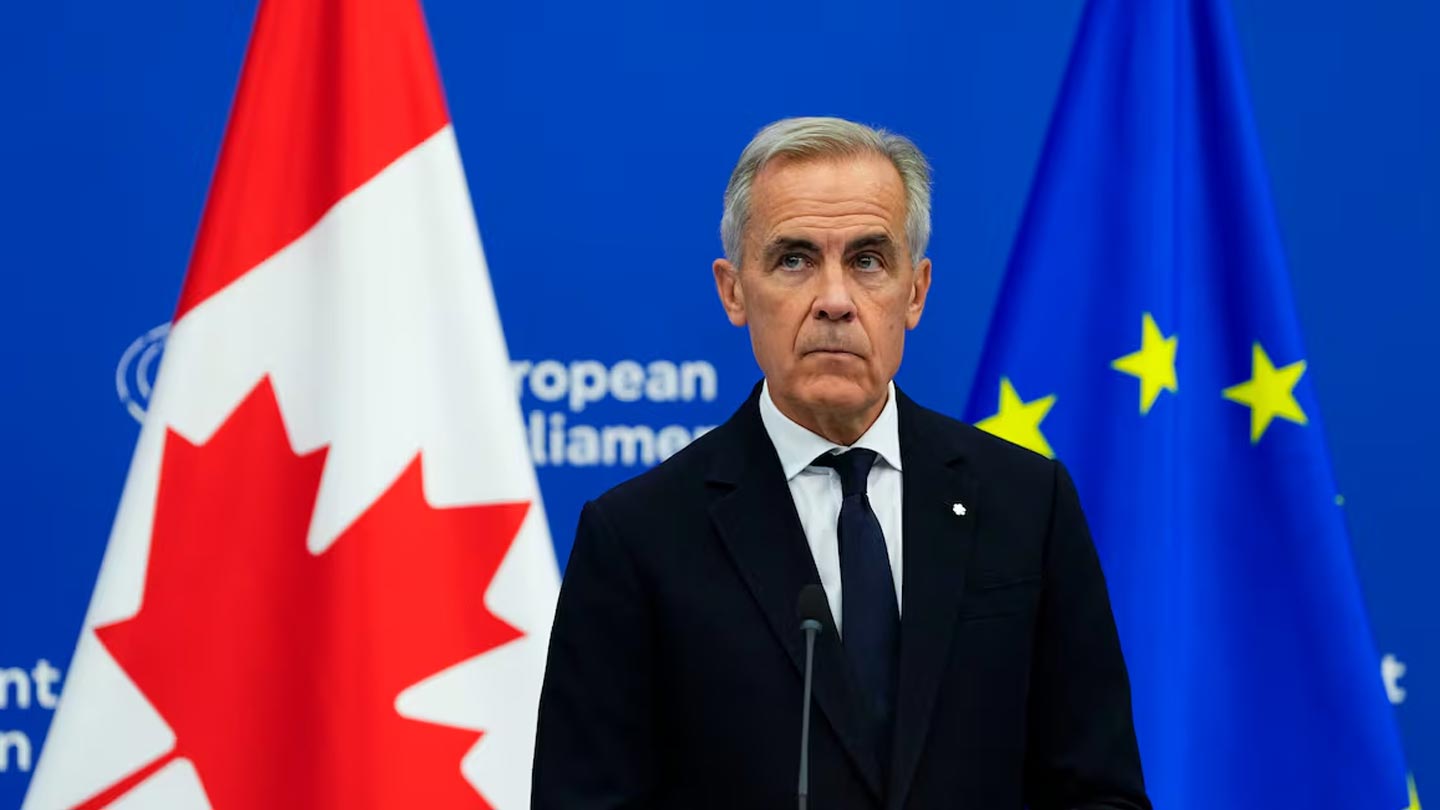
MONTREAL / OTTAWA – When Canadian and European leaders gather in Montreal this week for the Canada-EU Summit, the agenda will read like a wish list: digital trade, science, defence, artificial intelligence, student mobility and even a possible new kind of membership. The question hanging over it is whether the summit will deliver concrete results or simply more promises.
That is the message from Canada’s former envoy to Europe, who told CBC’s Rosemary Barton Live on Sunday that Canada needs tangible outcomes across the board. Dion said the country needs to see real results from its partnership with the European Union on trade, science, defence and security, and artificial intelligence. Prime Minister Mark Carney, for his part, has said the two sides are hammering out a “new, ambitious alliance.”
Digital trade: a deal within reach
The clearest near-term prize is a digital trade agreement. International Trade Minister Maninder Sidhu travelled to Ireland on Thursday to push talks forward, and in a statement said Canada and the EU were “closing in on an agreement.” The deal aims to reduce friction in modern cross-border commerce, covering e-signatures and e-contracts, paperless trade, secure cross-border data flows, duties on electronic transmissions and e-commerce.
The stakes are significant for Canadian business. Sidhu noted that Canada exported nearly $15 billion in digital services to the EU in 2024, and said an agreement would create an opportunity to grow that figure. The negotiations trace back to the last Canada-EU summit, held in Brussels on June 23, 2025, when the two sides launched talks on a digital trade agreement intended to complement the Comprehensive Economic and Trade Agreement, known as CETA, and fill gaps it did not cover. That summit also produced a new security and defence partnership, which includes an annual security and defence dialogue involving senior officials.
If the two sides announce a completed or nearly completed digital deal in Montreal, it would be the most tangible sign yet that the new partnership is moving from declarations to implementation. If it slips, critics will have fresh evidence that summit communiqués can outpace results.
A bigger idea: associate membership
Beyond trade, the summit has been shadowed by a more ambitious proposal. European Commission President Ursula von der Leyen has suggested that Canada could become the first associate member of the European Union, a concept that remains loosely defined. Reports ahead of the summit describe a possible arrangement that would preserve Canadian sovereignty while still giving Ottawa access to certain EU programs. Dion said the European Political Community would welcome Carney as “the most European of non-European countries,” and that Canada could take part without commitments such as financing or regulatory alignment.
Carney has also signalled interest in having Canada join Europe’s Erasmus+ student exchange program, an initiative that would give Canadian students and young professionals easier access to study and work in Europe. Dion pointed to student and professional mobility as another area where results are needed. Those who follow the file say mobility is one of the most visible ways a partnership can touch ordinary people, and one where progress can be measured quickly.
Science cooperation is another potential outcome. Canada has already agreed in principle to participate in EU research and innovation initiatives, and officials have discussed linking high-performance computing infrastructure and deepening collaboration on artificial intelligence and quantum technology. The 2025 summit outlined plans to allow Canada to participate in the EU’s AI Factories, and Montreal, a global hub for AI research, is a fitting venue to advance that work.
CETA’s unfinished business
Behind the new initiatives sits an older agreement that is still not fully in force. CETA was signed in 2016 and most of it, aside from the investment chapter, took effect provisionally in 2017. For it to take full effect, all EU member states must approve it, and as of now nine member states have not ratified the treaty. That means a significant portion of the trade relationship rests on a provisional footing, a point that critics of the new alliance often raise: before building new structures, they argue, both sides should complete the old one.
Supporters counter that the world has changed since CETA was negotiated and that the current moment calls for more than the original treaty can offer. They note that CETA has already eliminated the vast majority of tariffs between Canada and EU members, and that new agreements on digital trade, defence procurement and science fill gaps that matter more today.
The shadow of Washington
No analysis of the summit is complete without mention of the United States. Canada is under 50 per cent U.S. tariffs imposed in August after trade talks collapsed, and Ottawa responded in September with dollar-for-dollar counter-tariffs. Carney has made diversification of Canada’s trade and security partnerships a central theme of his government, saying Canada will build trade relationships with like-minded and reliable partners. He has also said Canada and Europe are not fair-weather allies, a pointed remark that came alongside criticism of Trump’s tactics.
For Europe, the incentives are mirror images. Facing its own uncertainties about Washington’s long-term policy and about the future of NATO, the EU sees Canada as a stable, like-minded partner with energy, critical minerals and a large market. The summit is therefore as much about geopolitics as about economics.
Still, some commentators urge caution about expectations. Critics argue that Canada already has trade agreements with Europe and the Asia-Pacific region through CETA and the Comprehensive and Progressive Agreement for Trans-Pacific Partnership, and that the work of expanding trade, including among provinces, remains largely domestic. Skeptics say the real test of the new alliance will be whether Canadian exporters and workers see benefits.
What success would look like
Officials are expected to announce the next steps in the deepening partnership at the summit. Observers say a successful outcome would include a signed or substantially concluded digital trade agreement, concrete steps on research cooperation and mobility, and clarity on what “associate” status could actually mean. A weak outcome, by contrast, would be a communiqué heavy on language and light on dates, funding and legal commitments.
For Carney, the summit is a chance to show that his strategy of building new alliances can deliver more than symbolism. For Europe, it is an opportunity to bind a trusted partner closer at a time of global uncertainty. And for Canadians, who are living with the daily consequences of a trade war, the measure of success will be simple: whether the deals struck in Montreal make it easier to sell goods, hire talent and study abroad.
Closing the Distance: Canada and Europe Head into Montreal Summit with Big Hopes and Higher Stakes
- October 26, 2026
- TSA News
Closing the Distance: Canada and Europe Head into Montreal Summit with Big Hopes and Higher Stakes
Tag :
Search Post
Popular Posts
Follow Us
Follow us on social media and never miss the latest updates, trending news, and exclusive stories.
0 Comments