

VANCOUVER – British Columbians delivered one of the most dramatic political reversals in the province’s history on Saturday night, handing the B.C. Conservatives a commanding majority government and ending close to a decade of NDP rule. The result also toppled a premier who had bet his career on an early election.
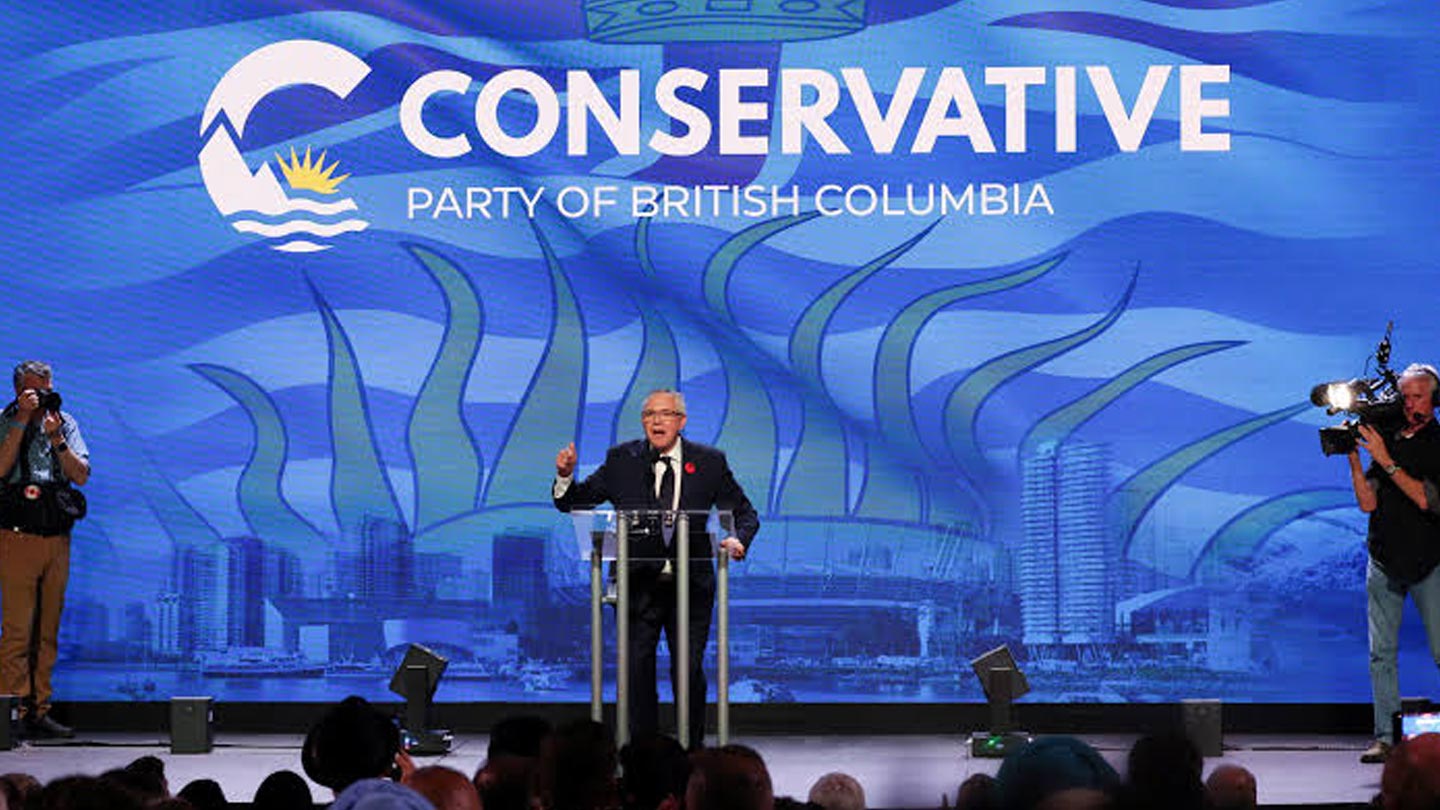
Interim leader Lorne Doerkson’s party was elected or leading in 62 of the province’s 93 ridings when he took the stage for his victory speech, according to CTV News, which was first to declare the outcome. By early Sunday morning, CBC News had the Conservatives leading in 64 ridings, with the NDP reduced to 27. Counts shifted slightly as late ridings were tallied, but every projection landed far beyond the 47 seats needed for a majority. The Greens held on to two seats, including the one won by party leader Emily Lowan in Saanich North and the Islands.
“We are going to super-charge British Columbia,” Doerkson told a roaring crowd of supporters. He will lead the province’s first Conservative government in nearly 100 years, a milestone that few observers would have predicted when the campaign began.
A premier’s gamble backfires
Premier David Eby called the snap election in September, roughly two years ahead of schedule. At the time, the B.C. Conservatives appeared to be in disarray. The party had been shaken by turmoil and defections, and its leader, Kerry-Lynne Findlay, had stepped down, leaving Doerkson to take over on an interim basis. The NDP’s calculation was straightforward: strike while the main opposition was divided and leaderless.
Instead, Doerkson moved quickly to bring wayward legislators back into the Conservative fold, and by the time the campaign was well underway, polls showed his party level with or ahead of the governing New Democrats. A Research Co. survey conducted in mid-October put the Conservatives at 44 per cent among decided voters against 42 per cent for the NDP. Another poll in the final week of the campaign showed the Conservatives ahead by five points. The televised leaders’ debate on Oct. 14 gave Doerkson, still unfamiliar to many voters, a chance to introduce himself to the province. By election day, the question was no longer whether the Conservatives would win, but by how much.
Polls closed at 8 p.m. Pacific time. Shortly before 9:30 p.m., Eby said he had phoned Doerkson to concede. In a somber speech to NDP supporters, he announced he was stepping down as party leader. “I accept full responsibility,” he said, acknowledging that several of his colleagues had lost their seats. Eby himself held on to his riding of Vancouver-Point Grey, but a number of NDP cabinet ministers were swept out of the legislature in the Conservative tide.
The man from the Cariboo
Doerkson’s rise has been remarkably swift. A former small-town newspaper publisher who lives in the Cariboo-Chilcotin region, he was first elected to the legislature under the former B.C. Liberal banner. He left BC United in 2024 to join the Conservatives, then found himself leading the party only weeks before the election was called. He has said he neither sought nor planned for the role. On Saturday, he won his own riding by a landslide, taking more than 70 per cent of the vote according to local reports.
His campaign was built on a short list of promises. He pledged not to raise taxes, a commitment he made in his first major policy announcement in Surrey on Sept. 27. He promised to focus on the economy, to keep hospital emergency rooms open, and to repeal the province’s Declaration on the Rights of Indigenous Peoples Act, known as DRIPA, while saying he wants First Nations as partners in the province’s development. He also positioned himself firmly against U.S. President Donald Trump’s annexation talk, describing Trump as a bully and declaring that B.C. would never become the 51st state on his watch.
Warnings that did not stick
The NDP campaigned on experience and policy continuity, arguing that returning power to a Conservative coalition that had spent much of the legislative term divided was a risky choice. The party also warned repeatedly that the Conservatives offered a political home to candidates and staffers with extremist views, including some separatist sympathies. Controversy followed Doerkson’s decision to stand behind his campaign director, Katy Merrifield, after a social media post emerged in which she criticized Islam in strong terms. Voters, in the end, were not deterred. Eby’s allies had also pointed to the government’s short-term rental restrictions and housing density measures as having helped bring down rents, but those arguments did not carry the night.
The Conservatives also had to contend with the fact that their leader was, on paper, a temporary one. The party’s constitution bars interim leaders from seeking the permanent post and requires a leadership race within the next year. The NDP seized on that, asking voters whether Doerkson could serve as premier for the long term. The Conservative board responded by promising to take the “appropriate means” to keep him in place, and the party said it would amend its constitution to allow it. Former leader John Rustad, who brought the party to the brink of power in 2024, did not seek re-election.
What the result means
For the NDP, the loss is as much a leadership crisis as an electoral one. The party now faces a rebuilding process and a search for a new leader, after nearly a decade in government under John Horgan and then Eby. Observers say the result is a cautionary tale about the risks of calling a snap election to exploit an opponent’s weakness: the same turmoil that made the Conservatives look vulnerable in September forced them to unite, and voters rewarded that unity.
The night was not a triumph for turnout. The Canadian Press reported that voter participation in the snap vote was lower than in the 2020 pandemic election, a sign that an early campaign may have left many British Columbians disengaged, even as those who did vote delivered a decisive verdict.
The result also lands at a sensitive moment for the country. The federal government under Prime Minister Mark Carney has been advancing major energy projects in B.C. and Alberta, and trade relations with Washington remain badly strained. A Conservative government in Victoria, aligned in outlook with the government in Edmonton and Regina, changes the political map of Western Canada, with consequences for how the provinces deal with Ottawa on resource development, Indigenous relations and trade.
For now, the immediate task belongs to Doerkson and his team: assembling a cabinet, setting a legislative agenda and turning a slogan into a government. Eby, who spent years building a reputation as a pragmatic and combative premier, leaves a party in shock. “This is a critical time for our province and for our country,” he told supporters as he wished his successor well. British Columbia’s next chapter, whatever it brings, begins with a political earthquake few saw coming.
Blue Wave in the West: B.C. Conservatives Topple the NDP in a Historic Landslide
- October 26, 2026
- TSA News
Blue Wave in the West: B.C. Conservatives Topple the NDP in a Historic Landslide
Tag :
Search Post
Popular Posts



Follow Us
Follow us on social media and never miss the latest updates, trending news, and exclusive stories.
0 Comments